


In November, many seasonal tour and activity operators have a quiet calendar and a full inbox of holiday shoppers looking for something to give. A gift card turns that gap into cash now and a booked guest later. The short answer for tour operators is simple: put a clear, fixed-value or tour-specific gift card on the homepage and every tour page before Black Friday, email it to past guests twice, and set terms that follow the federal gift card rules.
TL;DR
- Holiday shoppers already plan to buy gift cards: 43% of shoppers in the National Retail Federation’s 2025 holiday survey planned to buy at least one.
- Sell two formats: a fixed-value card in round amounts and a tour-specific card that names the experience.
- Make the gift card visible on the homepage, every tour page and the booking confirmation email from mid-November through December 24.
- Email past guests at least twice: once before Black Friday and once in the last week before Christmas.
- Under federal rules, most purchased gift card funds must stay usable for at least five years, and inactivity fees are tightly limited. Check your state’s rules too.
- Track gift card revenue separately so you can plan staffing for the spring redemption wave.
Why Should Tour Operators Sell Gift Cards in the Off-Season?
Gift cards are worth selling in the off-season because they bring in revenue during the quiet months between seasons, and they bring a new guest to the business when the card is redeemed. The buyer pays in November or December. The recipient books a date in spring or summer, often with friends or family who pay full price.
Demand is already there. The National Retail Federation’s 2025 holiday survey found that 43% of holiday shoppers planned to buy at least one gift card, and that consumers planned to spend $29 billion on gift cards for the season. Most shoppers told NRF they planned to buy restaurant, bank-issued or department store gift cards. Experiences are gaining ground: NRF’s 2026 survey found that 27% of holiday shoppers plan to give an experience as a gift, up from 19% five years ago. A tour operator who makes a gift card easy to find gives shoppers an option that feels more personal than a store card and is still a one-click purchase.
There is a direct booking benefit too. A gift card sold on the operator’s own website carries no OTA commission, and the buyer’s email address belongs to the operator. That makes the gift card one of the few products that grows both off-season revenue and the email list at the same time.
What Kind of Gift Card Should a Tour Business Offer?
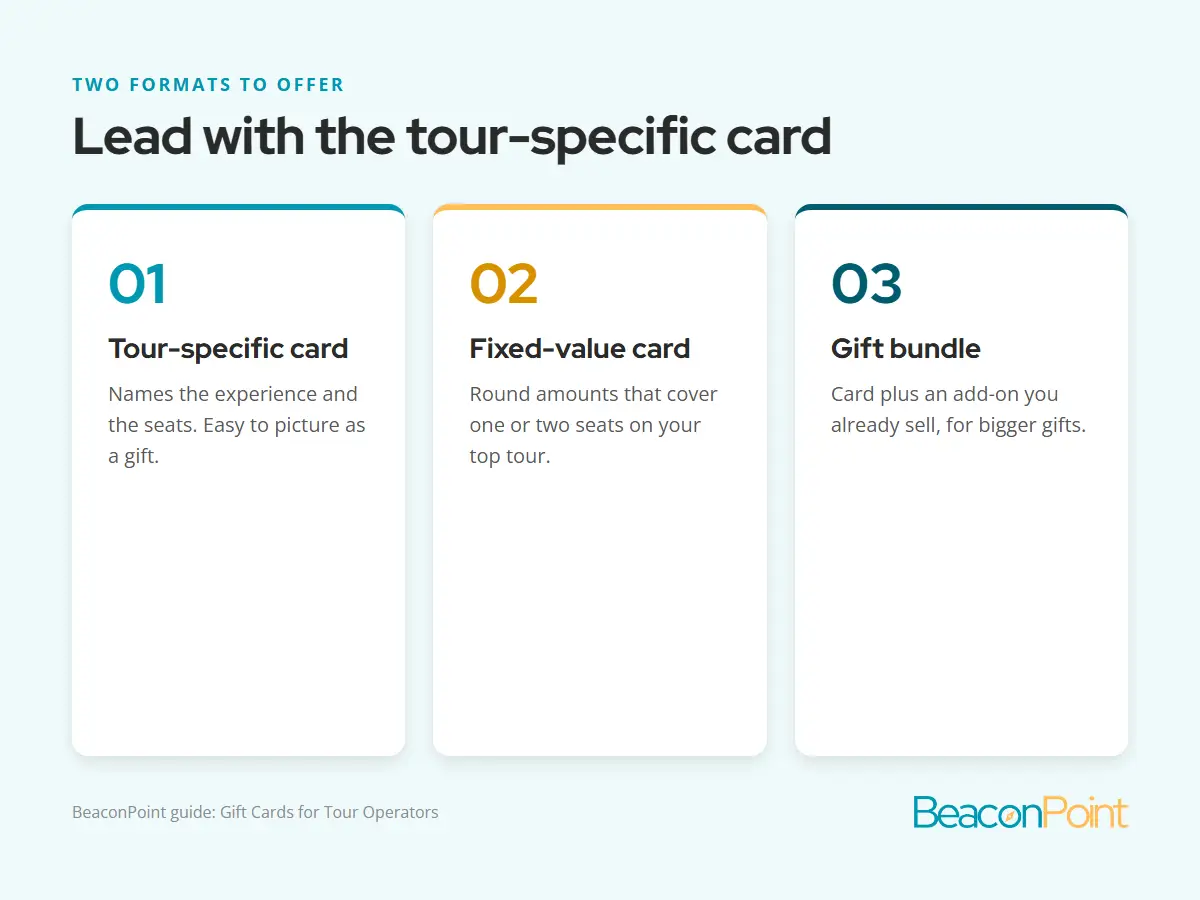
A tour business should offer two gift card formats: a fixed-value card and a tour-specific card. Each one solves a different buyer problem.
| Format | Best For | How to Set It Up | Watch Out For |
|---|---|---|---|
| Fixed-value card (for example $50, $100, $150) | Buyers who are unsure which tour the recipient wants | Round amounts that cover one or two seats on your most popular tour | Amounts that sit just below a ticket price, which forces an awkward top-up |
| Tour-specific card (“Two seats on the Sunset Paddle”) | Buyers who want the gift to feel like an experience rather than cash | Name the tour, the number of seats and what is included | Price changes before redemption; state in the terms how a price increase is handled |
| Gift bundle (card plus merchandise or a photo package) | Higher-value gifts and corporate buyers | Pair the card with an add-on you already sell | Shipping deadlines for anything physical |
Many booking platforms built for tours and activities include a gift card or voucher feature, so check yours before buying a separate tool. The feature should let the buyer choose an amount or a tour, add a message, and send the card by email to themselves or the recipient on a chosen date.
Should a gift card be a dollar amount or a specific tour?
Offer both, and lead with the tour-specific card in your marketing. A named experience (“a food tour for two in Greenwich Village”) is easier to picture as a gift than a dollar figure. Keep the fixed-value card as the fallback for buyers who are unsure.
Where Should Tour Operators Promote Gift Cards?
Tour operators should promote gift cards in the places where shoppers already are on the site and in the inbox, starting in mid-November. A gift card hidden in the footer sells almost nothing.
Put the offer in these places:
- Homepage. A banner or a section near the top from mid-November through December 24, with one button: “Buy a Gift Card.”
- Every tour page. A short line under the Book button: “Giving this tour as a gift? Buy a gift card.”
- Booking confirmation emails. Guests who book a spring tour in November are often the same people shopping for gifts.
- Google Business Profile. A post with the gift card link, refreshed before Black Friday and again in mid-December.
- Social media. Two or three posts between Black Friday and Christmas, each showing the experience being given rather than the card itself.
What dates matter most for holiday gift card sales?
The key dates are Black Friday (November 27, 2026), Small Business Saturday (November 28), Cyber Monday (November 30) and the last week before Christmas. Gift cards delivered by email have no shipping deadline, so the final days before December 25 are a selling window that physical gifts lose. Say so in the copy: “Delivered instantly by email.”
How Do You Email Past Guests About Gift Cards?
Email past guests at least twice, because they are the most likely buyers: they know the tour is worth giving. The first email goes out before Black Friday and the second in the last week before Christmas.
The first email reminds guests of the tour they took and offers it as a gift. Keep it short: one photo from the tour, one sentence on why it makes a good gift, the gift card button, and the line “Delivered instantly by email.” The second email is a last-minute reminder for shoppers who still need a present.
If your guest list has gone quiet since their tour, start with a short note thanking them for coming before you ask them to buy. BeaconPoint’s guide to email marketing for tour operators covers how to grow the list and win back past guests in more detail.
One BeaconPoint client, Golden Boat Rentals, plans its off-season around this pattern: gift cards and a Boat Club offer carry the November to December calendar outside its May to September boating season. The approach suits any seasonal operator whose guests come back to the same place every year.
What Rules Apply to Tour Gift Cards?
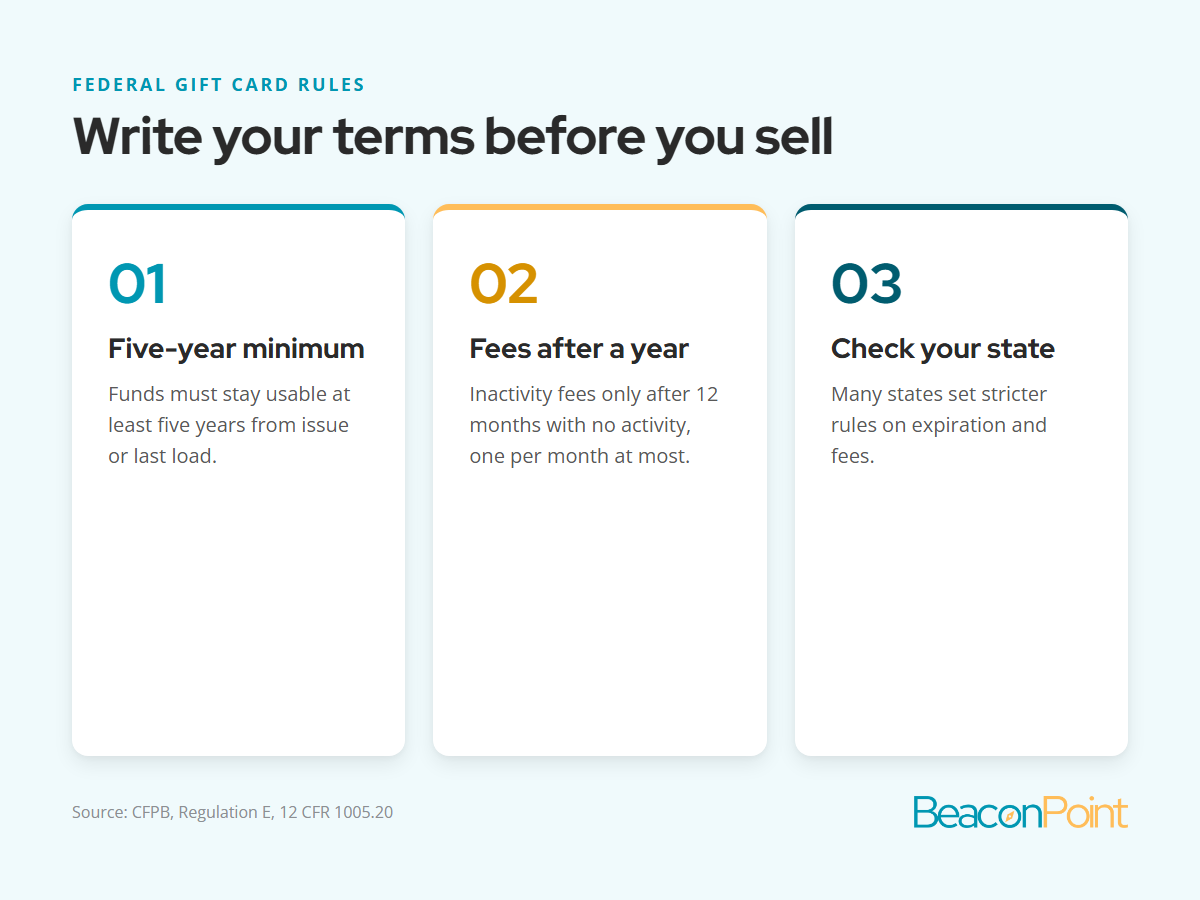
In the United States, Regulation E sets the federal gift card rules. Under Regulation E, which implements the Credit CARD Act of 2009, the funds on a gift certificate or store gift card must stay usable for at least five years after the card was issued or last loaded. A dormancy, inactivity or service fee can only be charged after a full year with no activity, and no more than one such fee in any calendar month. The expiration date and any fees must be disclosed clearly before purchase and printed on the card itself, or shown on an emailed card. (Source: Consumer Financial Protection Bureau, 12 CFR 1005.20.)
The federal rule excludes some cards, including cards issued in paper form only and cards redeemable solely for admission to events or venues at a particular location. Some tour gift cards may fall under that exclusion, so the simplest choice is to follow the federal standard anyway and confirm your state’s law.
Many states add stricter rules, and some ban expiration dates or fees entirely. The National Conference of State Legislatures keeps a summary of state gift card laws. Check your state before you write the terms, and ask your accountant how to record gift card sales, since many businesses treat unredeemed cards as a liability until they are used.
Three terms to write down before you sell:
- What happens if the tour price rises before the card is redeemed.
- Whether the card can be used for any tour or only the one named.
- How the recipient books: online with a code, or by calling the office.
Free promotional cards, such as a “spend $100, get a $20 bonus card” offer, are treated differently from purchased cards under the federal rule. To qualify as a promotional card, the front of the card must say it is promotional and show its expiration date, and the card must list any fees and a toll-free number for fee questions.
How Do You Measure Gift Card Sales?
Measure gift card sales as their own line in your booking reports: number sold, total value and average value, by week. That makes it possible to compare this season with next and to see which promotion moved sales.
Then track redemption. Note the month each card is redeemed and how many extra seats were booked alongside it. For seasonal operators, many cards come back in spring and summer, so the redemption report also tells you how many of next season’s early bookings are already paid for, which helps with staffing and pricing decisions.
If your analytics records gift card purchases as normal bookings, label them separately. Without that label, December revenue will look like a surge in tour demand and distort next year’s plan.
Frequently Asked Questions
Do gift cards for tours expire?
Under federal rules, the funds on a purchased gift card or gift certificate must stay usable for at least five years from the date it was issued or last loaded, and some states set stricter limits. Free promotional bonus cards can carry a shorter expiration date when the front of the card says it is promotional and shows that date.
When should tour operators start promoting holiday gift cards?
Start in mid-November, so the offer is live on the website and in a first email before Black Friday on November 27, 2026. Keep promoting through December 24, since emailed gift cards have no shipping deadline.
Should tour operators sell gift cards through OTAs?
Sell gift cards on your own website first. A card sold directly carries no OTA commission, and the buyer’s email address stays with your business for future marketing.
What gift card amounts work best for tour operators?
Round amounts that cover one or two seats on your most popular tour work best, along with a tour-specific option that names the experience. Avoid amounts that fall just below a ticket price.
How do tour operators handle price increases on gift cards?
State the policy in the gift card terms before you sell. Common approaches are honoring the named tour regardless of price, or applying the card’s dollar value toward the current price.
Summary
- Gift cards turn the off-season into revenue now and booked guests later, with no OTA commission when sold direct.
- Offer a fixed-value card and a tour-specific card, and lead with the tour-specific one.
- Promote the card on the homepage, every tour page, confirmation emails, Google Business Profile and social from mid-November to December 24.
- Email past guests before Black Friday and again in the last week before Christmas.
- Follow the federal five-year rule and your state’s gift card law, and write clear terms for price changes.
For more off-season ideas, see BeaconPoint’s guide to Off-Season Marketing for Tour Operators: What to Do From October Through February. To find the other places your tours lose bookings before spring, download the free Empty Seat Diagnostic.
Sources
- National Retail Federation, “Gift cards gain popularity as top choice for holiday shoppers in 2025” (https://nrf.com/blog/gift-cards-gain-popularity-as-top-choice-for-holiday-shoppers-in-2025): 43% of holiday shoppers planned to buy at least one gift card; planned gift card spending of $29 billion; restaurant, bank-issued and department store cards most popular.
- National Retail Federation, “2026 holiday shopping trends: What consumers are planning” (https://nrf.com/blog/2026-holiday-shopping-trends-what-consumers-are-planning, Oct 28, 2026): 27% plan to give an experiential gift, up from 19% five years ago.
- Consumer Financial Protection Bureau, Regulation E, 12 CFR 1005.20, “Requirements for gift cards and gift certificates” (https://www.ecfr.gov/current/title-12/part-1005/section-1005.20): five-year minimum on fund expiration; dormancy, inactivity or service fees only after one year of inactivity and no more than one per calendar month; disclosure before purchase and on the card; exclusions for paper-only cards and single-location admission cards; promotional card conditions.
- National Conference of State Legislatures, “Gift Cards and Gift Certificates Statutes and Legislation” (https://www.ncsl.org/financial-services/gift-cards-and-gift-certificates-statutes-and-legislation): summary of state gift card laws.