


Most tour operators sign up with Viator or GetYourGuide once, accept the default settings, and never look at the terms again. Meanwhile the platforms keep adjusting commission rates, visibility programs, and payout options. October, with a full season of booking data in hand and next season’s listings about to be set, is the right time for a deliberate review.
TL;DR
- OTAs are a larger share of bookings than ever: Arival’s 2026 operator survey found 37% of bookings now go through OTAs, while direct bookings fell to 25% of sales in 2025.
- Start with the real commission you paid in 2026, including any visibility program or payout fees, not the rate you remember signing.
- GetYourGuide raised some operators’ commission to 30% or more in 2025, and several operators had increases reversed after contacting support (Source: Arival).
- Check six areas: commission and programs, pricing and parity, cancellation policy, payout terms, listing quality, and guest data.
- Do not try to leave OTAs overnight. Use the review to price them correctly and to move repeat guests to direct booking.
Why OTA Contracts Deserve an Annual Review
Arival’s Global Operator Landscape (4th Edition, April 2026), based on 5,664 operators, found that 37% of bookings now go through OTAs, up sharply from 2024, while direct bookings fell from 29% of total sales in 2024 to 25% in 2025. For many operators, OTA commission is now the single largest cost of acquiring customers, which is why deciding how to use OTAs deserves a deliberate plan.
The terms are not fixed. In June 2025, GetYourGuide notified some operators of commission increases that reached or passed 30%, effective the following month, according to Arival. Operators objected to the short notice and peak-season timing, and several who disputed the change through operator support had the increase reversed. The lesson is simple: read every notice, and ask.
Step 1: Calculate What You Actually Paid
Before reviewing any terms, pull 2026 payout statements from each OTA and calculate:
- Gross booking value sold through the OTA
- Total commission and fees withheld
- Effective commission rate (total withheld divided by gross booking value)
The effective rate is often higher than the headline rate, because visibility programs and payout options add points. Viator does not publish a standard supplier commission rate, and its Accelerate program lets operators pay a higher commission in exchange for more visibility (Source: Arival). GetYourGuide sets rates by contract, and some booking software providers report that faster payout options raise the rate further.
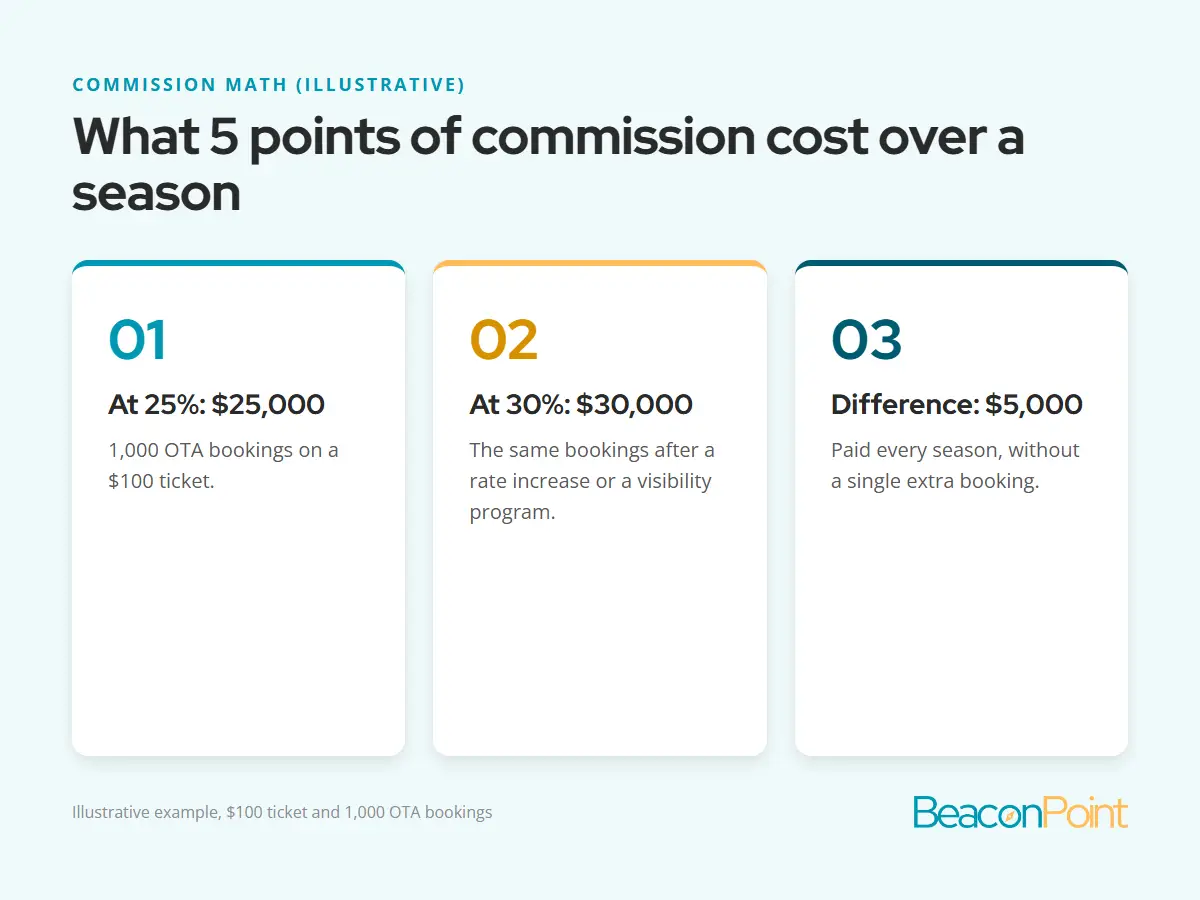
Here is what a few points of commission mean over a season, using an illustrative $100 ticket and 1,000 OTA bookings.
| Commission Rate | Commission per Booking | Season Commission (1,000 Bookings) |
|---|---|---|
| 20% | $20 | $20,000 |
| 25% | $25 | $25,000 |
| 30% | $30 | $30,000 |
| 35% | $35 | $35,000 |
Moving from 25% to 30% costs this operator $5,000 a season without a single extra booking. That is why the effective rate matters more than the rate on the original contract.
Step 2: The OTA Contract Review Checklist
Work through each area for every OTA. Mark anything unclear and raise it with the platform’s supplier support before next season’s listings go live.
| Area | What to Check | Why It Matters |
|---|---|---|
| Commission and programs | Effective rate, any visibility or promotion programs you opted into, and whether the extra visibility produced extra bookings | Programs that add commission without adding bookings are pure cost |
| Pricing and parity | Any terms about pricing relative to your own website or other channels | Your own website should never be the most expensive place to book you |
| Cancellation policy | The policy shown to OTA guests and whether it matches your direct policy | Mismatched policies create disputes and refund losses |
| Payout terms | Payout frequency, any fee for faster payouts, currency conversion | Faster payouts can quietly raise your effective rate |
| Listing quality | Photos, descriptions, inclusions, meeting point, and review responses | A strong listing earns more bookings at the same commission |
| Guest data | What contact information you receive and what you are allowed to send guests | It decides whether you can invite OTA guests to book direct next time |
Commission and Visibility Programs
Compare bookings before and after joining any visibility program. If the extra commission did not bring extra bookings, ask to leave the program or reduce the rate. If you were notified of a rate increase, ask support for the reason and whether it can be reviewed. Operators who asked GetYourGuide in 2025 were sometimes successful.
Pricing and Rate Parity
Read the pricing terms in each agreement, including Viator’s retail price rules. Some OTA agreements ask suppliers not to offer the same product for less elsewhere. Whatever the terms say, a guest who finds your tour on an OTA and then visits your website should never see a higher price there. Instead of undercutting the OTA on price, give direct bookers a reason to book with you: a small add-on, better date selection, or a more flexible cancellation policy, where your agreement allows it.
Cancellation Policy and Payouts
Confirm the cancellation policy each OTA shows guests matches what you can honor operationally. Then review payout settings. If you pay extra for faster payouts, compare that cost with your actual cash flow needs. Many operators can switch to the standard schedule in the off-season.
Listing Quality
Put each OTA listing side by side with the same tour on your website. Check price, photos, description, inclusions, reviews, and cancellation terms. Your website should match or beat the OTA on every line. If the OTA listing is better, fix your website first; it is the page that earns commission-free bookings.
Guest Data
Review what guest information each OTA shares and what communication it permits. Within those terms, make sure every guest who books through an OTA has an excellent experience and leaves knowing your business name and website, so the next booking can come direct.
Step 3: Decide What to Change for Next Season
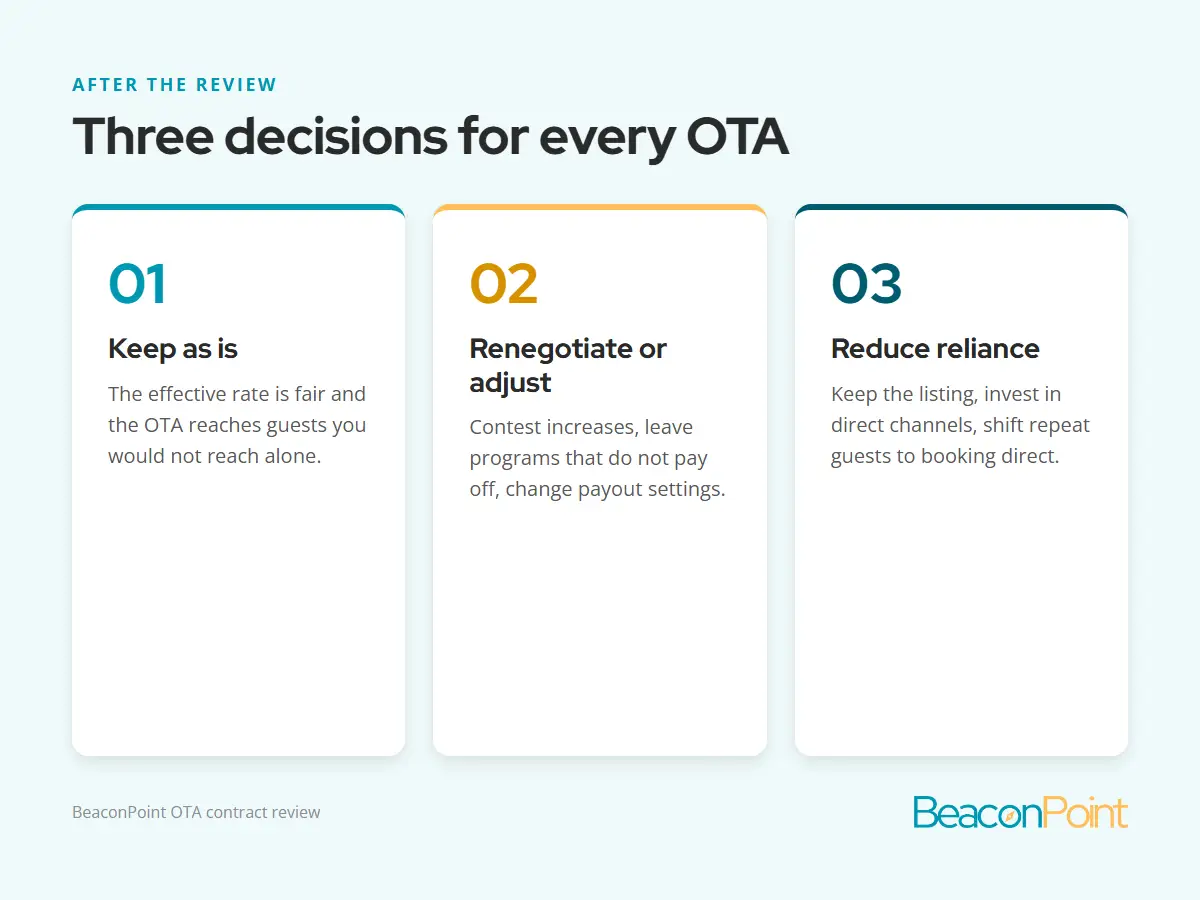
After the review, most operators land on one of three decisions for each OTA:
- Keep as is: the effective rate is reasonable and the OTA brings guests you would not reach otherwise.
- Renegotiate or adjust: leave programs that do not pay off, contest rate increases, or change payout settings.
- Reduce reliance: keep the listing, but invest in direct channels so a smaller share of total bookings depends on the OTA.
The real risk with OTAs is rarely the platform itself; it is not knowing what it costs. An operator who knows the effective rate per booking can compare it with the cost of a direct booking and decide where each marketing dollar does the most good.
Frequently Asked Questions
What commission do Viator and GetYourGuide charge tour operators?
Neither publishes a single standard supplier rate. Rates are set by contract, and booking software providers commonly report ranges of about 20% to 30%. Visibility programs and some payout options add to the base rate, so the effective rate is best calculated from your own payout statements.
Can tour operators negotiate OTA commission?
Sometimes. In 2025, several operators who contested GetYourGuide commission increases through operator support had them reversed, according to Arival. Leaving visibility programs that do not produce bookings is another way to lower the effective rate.
What is rate parity for tour operators?
Rate parity means offering the same price across channels. Some OTA agreements include terms about pricing relative to other channels, so operators should read their agreements. In practice, the operator’s own website should never be more expensive than an OTA listing.
Should tour operators stop using OTAs?
Not usually. OTAs reach travelers an operator might not reach alone. The goal is to know the real cost per OTA booking, avoid paying for programs that do not perform, and grow direct bookings so the business depends less on any one platform.
When should tour operators review OTA contracts?
At the end of each season, with full booking and payout data in hand, and whenever an OTA sends notice of a change in terms or commission.
Summary
- Calculate the effective commission rate from 2026 payout statements, including programs and payout fees.
- Review six areas for each OTA: commission and programs, pricing and parity, cancellation policy, payouts, listing quality, and guest data.
- Contest rate increases and leave programs that do not pay off.
- Make sure your website matches or beats every OTA listing.
- Use the results to set next season’s channel mix.
BeaconPoint’s free 2027 Marketing Budget Planner for Tour Operators includes an OTA commission worksheet that turns this review into next year’s budget. Operators who want help can talk to BeaconPoint.
Sources
- Arival, The Operator’s Marketing Playbook, The Global Operator Landscape (4th Ed.), April 2026: 37% of bookings through OTAs; direct bookings fell from 29% of sales in 2024 to 25% in 2025; 5,664 operators surveyed.
- Arival, GetYourGuide Commission Increasing for Some Operators, June 2025 (updated July 2025): increases to 30% or more for some operators; several reversed after operators contacted support.
- Arival, Viator Accelerate: What It Means for Operators: operators can opt into higher commission for more visibility.
- Commission ranges of about 20% to 30% as reported by booking software providers’ supplier guides (for example Regiondo and Xola).